Taking Control of Calf Housing and Health: 24/7, 365 Control for your Calves
The beginning
MoDak Dairy, of Goodwin, South Dakota is making remarkable strides in raising healthy calves efficiently, economically, and by keeping the work environment of their employees in mind. MoDak is owned and operated by brothers Greg and Jim Moes, along with Greg’s son Jacob. They discussed raising all their own replacement heifers from birth on up.
MoDak Dairy wanted to add separate, modernized housing for their young milk calves that would give them environmental control all year round. At first, the wet calves were at the homestead site in hutches and old freestall buildings. MoDak fought multiple issues with their calves including pneumonia and bedding by 8 weeks of age. They knew they needed to change how they raised their calves and become more efficient.
They had toured a “Hatfield” barn in Iowa that had group penning with bottle feeders on one side and grain feeding on the other which intrigued them. This led to their first true indoor calf barn that they converted from an old turkey barn. The turkey barn design consisted of 12 pens with 9 calves per pen and had positive pressure tube ventilation as well as end wall fans for the summer time. This overall layout ended up working great for MoDak but they still had issues with ventilation. When the new heifer building plans began, they knew they wanted to build new and improved calf barns as well so that they could house all their youngstock at one site.
Indoor calf housing design
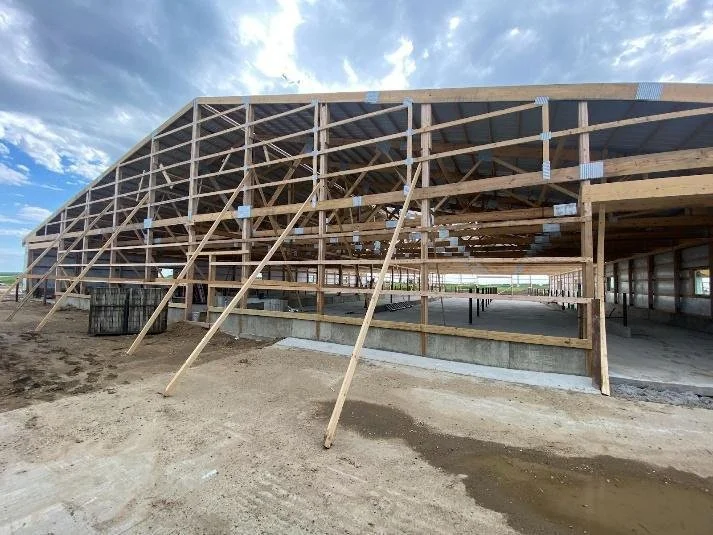
The new calf barn was modeled after the turkey barn, but at a larger scale and with better ventilation. Numerous conversations about overall design, labor efficiency and ventilation types here had amongst Jacob and Greg. They wanted to build a calf barn that would be top of the line so they can raise the healthiest calves possible.
Their final design ended up consisting of 2 separate rooms in one 100’ x 150’ building that each houses up to 108 calves per room. The group pen design mimics their existing indoor calf barn (turkey barn) with 12 pens consisting of 9 calves each due to headlock spacing. The calves enter at 24 hours old and stay until they are weaned at 8 weeks. Their first calf barn was built in 2021 and was populated with day-old calves that December. This all-in-all-out design takes 1-2 days to fill one pen, and 10-14 days to fill one room. The well thought out design allows workers to clean the pens quickly with only two loader passes. The calves are cleaned out and provided with fresh clean bedding once a week. This design also allows workers to do a thorough cleaning and sanitizing of the rooms once all the calves are moved out before the next group of calves arrive.
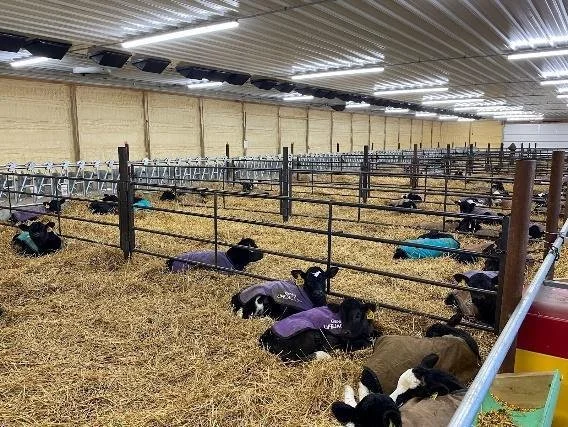
After touring multiple other calf facilities, MoDak knew they needed to get their ventilation right. Jacob and Greg discussed several options and wanted to stay away from positive pressure tubes. They teamed up with specialists from Tunnel Plus and SKOV to implement a newer concept of ventilation to the dairy calf housing world. The ventilation system consists of 3, variable-speed chimney fans per room along with 74 ceiling inlets that have been strategically placed to allow fresh air into the calf space and direct that air where it is most beneficial depending on the outdoor climate. The negative-pressure ventilation system is modeled after the same ventilation systems used in swine and poultry housing.
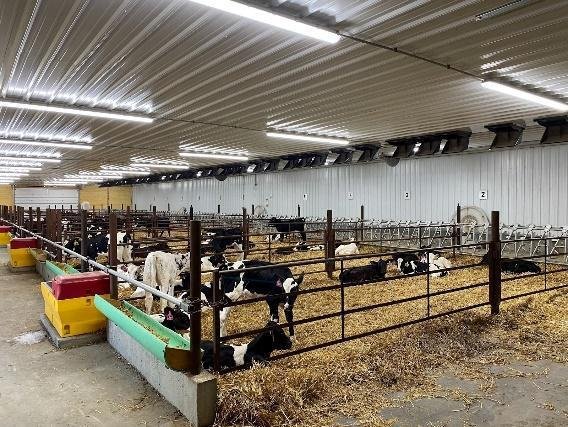
Fresh air is drawn into the attic space in the building through the sidewall eaves and then enters the calf area through the inlets. The chimney fans exhaust the stale air through the roof. A highly-technical controller is used to adjust fan speed and inlet opening and allows endless adjustability year-round.
During the winter months specific inlets are selected to open slightly to allow fresh air into the calf space without drafting the calves. As daily temperatures change, the controller will then engage more inletting as needed. In the hot summer months, the inlets are open to their full extent and fast-moving air is shoveled down onto the calves to keep them cool. Temperature and humidity sensors are located throughout the building and outside of the building so that the controller can continually adjust to provide the calves with a comfortable environment.
New adventures
Today, MoDak has three identical calf barns. The expansion of their calf housing not only includes their replacement heifers, but their beef crosses as well. They have used genomic testing ever since it has become available and breed the top 40% of their herd with sexed Holstein semen. The rest of their cows are serviced with sexed Limousin semen. Recently however, MoDak is taking on a new venture: Akaushi Beef. This beef breed is a Waygu cross, and their plan is to sell these Akaushi crossbreds to a company in Texas that is willing to pay a premium for this breed.
When asked what they liked the most about the new set-up, Greg stated, “I love that there is adjustability in the ventilation system. The controller changes the fan speed automatically during the different seasons.” His advice to producers on the fence about building a new calf facility like theirs is, “This design allows for a reduced labor force with the ease of tasks like feeding milk, grain, and cleaning out pens, which is a great labor savings. We have seen more consistent daily gains throughout the groups, and these barns also provide a very comfortable environment not only for the calves, but also for the workers.”

Brent Hershey,
President
Tunnel Plus™
4-Season Ventilation & Cooling Systems